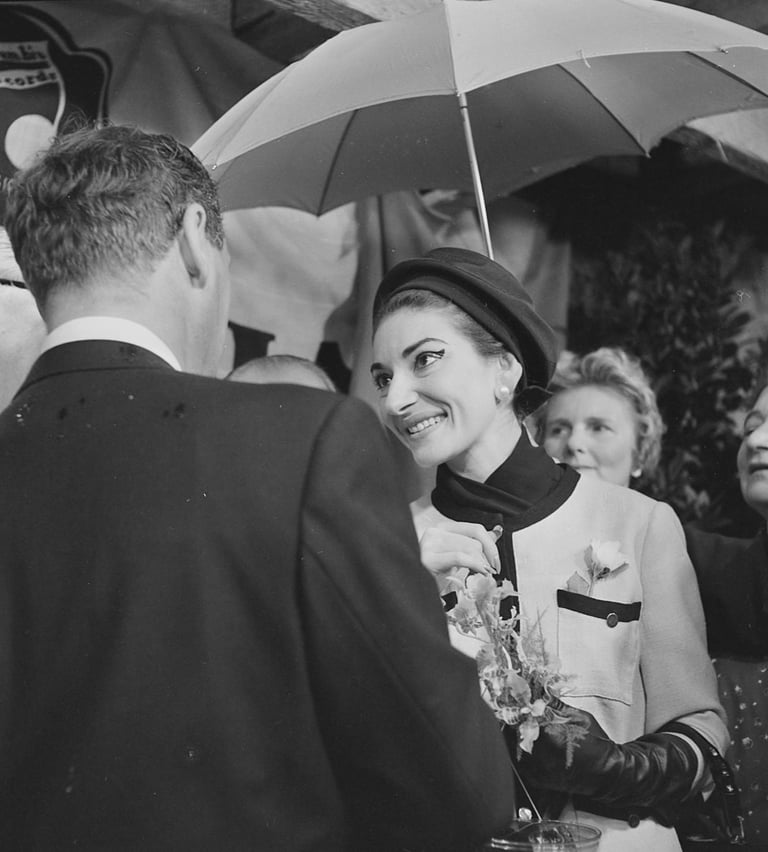

The following is an essay I wrote for a course in musicology at the University of Helsinki. I chose Maria Callas as my topic because reflecting on her elegance is, quite frankly, one of my favorite pastimes.
I began studying musicology in 2020, and since 2022 I’ve delved deeply into Callas’ life and career. In 2024 I lived in central Paris, where I often retraced her steps. Toward the end of the year, I reread all her letters and memoirs in French. Inspired by those letters, I wrote this essay, which I completed on December 28th, 2024, just before returning to Helsinki.
Enjoy!
In Maria Callas' Shoes
Let us, for a moment, step into the shoes of soprano Maria Callas (1923–1977). Of course, no one could truly fill her place in the history of opera — but what might it have felt like to be “Maria Callas”? To sing with her lungs, to feel the resonance of her voice inside her head? To see the world through her nearsighted eyes from a height of 172 centimeters? To speak fluent English, Greek, Italian, and French? To feel the fabric of her gowns and the weight of her diamonds against her skin? To hear the roar of applause, night after night? To practice opera roles alone at the piano? To walk from stage to stage, city to city, in the flash of paparazzi bulbs?
The best way to glimpse what it was like to live in Callas’ shoes is through her legacy of over 300 letters and her dictated memoirs from 1957 and 1977. Filmmaker Tom Volf compiled and translated these archival texts into French in Maria Callas: Lettres et mémoires (2019). The book includes clarifying footnotes as well as a chronological list of her performances corresponding to the letters. The earliest letters date from 1946, and the final ones were written just months before her death in Paris.
In my bachelor’s thesis, “The Elegance of a Female Singer’s Appearance and Performance: Maria Callas, Caterina Valente, and Barbra Streisand as Elegant Performers in the 1960's” (2023), I examined the concept of elegance through three televised performances from the 1960's, including Callas’s 1962 performance of Georges Bizet’s Carmen aria “L’amour est un oiseau rebelle” at Hamburg’s Laeiszhalle. There, I proposed a three-tiered theory of elegance: first, skillful selectivity; second, a refined balancing of the chosen elements; and third, the appearance of effortlessness in maintaining that balance. In other words, when effortlessness — or at least the illusion of it — is achieved, we can truly speak of elegance.
After completing that thesis, I wanted to deepen my understanding of elegance specifically in relation to Maria Callas. While reading her letters and memoirs, I compiled a set of observations (see Appendix 1) noting every passage that referred to her own appearance—or, more broadly, to appearance in general.
It is undeniable that the materials that touch our skin and surround us play a profound role in shaping our experience of life. We can never fully know Callas’s inner emotional world, but we can learn something about life in her shoes by deconstructing the material, ideological, and social aspects of her appearance. What social position did she occupy, and why was it so essential that she looked the way she did? What practical effort did she invest in crafting and maintaining an elegant appearance? In which contexts was it most important for her to project elegance, and in which was it less so? And how do our perceptions of her appearance today differ from those of her contemporaries?
For this essay, I limit these questions to the 1950's, a period when ideals of elegance permeated Western women’s fashion and beauty culture — and when Callas was at the height of her international career. I use the term appearance as I did in my bachelor’s thesis: a neutral concept encompassing all of a person’s outward qualities — clothing, accessories, physical features, and overall bearing.
I begin with the 1950's context, outlining the prevailing ideals of feminine appearance in the West. I then compare these ideals with Callas’s position as an international opera star, reflecting also on her attitude toward beauty and adornment as a young soprano at the end of the 1940's. For this, I draw on Päivi Aikasalo’s dissertation, Seuratkaamme järkevää ja terveellistä muotia: Naisten pukeutumisihanteet ja vaatevalinnat 1920-luvulta 1960-luvun lopulle (2000), which discusses the demands of elegance on women’s fashion in the 1950s, as I also did in my earlier thesis.
The second conceptual and historical framework of this essay is glamour. In Glamour: History, Women, Feminism, Carol Dyhouse examines in detail the ways glamour and femininity intersect, how glamour is tied to fashion, and what glamour has meant to women throughout the twentieth century. Glamour, she argues, is deeply entwined with femininity, consumerism, popular culture, and shifting notions of celebrity (2010: 1). Dyhouse connects glamour especially to clothing, cosmetics, and other aspects of material culture, since women’s social history is closely bound up with them (2010: 7). This perspective is also crucial when considering Callas’s appearance in relation to the concept and history of glamour.
The essay unfolds, as it were, from the outside in. I first examine the outward qualities of Callas’ elegance, then the practical arrangements that sustained it, and finally the role of her inner beauty and elegance in her enduring appeal. I consider the latter essential, since the very nature of elegance hinges on the interplay between outer and inner qualities—as I demonstrated in my bachelor’s thesis.
Ultimately, this essay shows that Callas made significant efforts to shape her appearance and succeeded in embodying the 1950s ideal of female elegance, in part by drawing upon the iconography of glamour. Yet her outward elegance was always complemented by an inner elegance, which made her presence all the more compelling.
Callas and the Ideal of Female Appearance in the 1950s
In her dissertation, Päivi Aikasalo summarizes the demands placed on women’s appearance and image in the 1950's as follows:
“The 1950's appear to have been particularly demanding when it came to dress. A polished look, clothes suited to the occasion, matching accessories, and carefully composed ensembles were all considered essential. It was important to avoid mistakes and to master the rules of etiquette. … The female ideal of the 1950's was the feminine and elegant housewife, who devoted herself above all to home and children.” (2000: 258)
Although Aikasalo’s study focuses on the ideals presented in the Finnish magazine Kotiliesi between the 1920's and 1960's, they reflect broader Western ideals of appearance at the time. Finnish housewives may not have received exactly the same style instructions as Parisian society ladies, but the underlying demand for elegance was the same everywhere. Women were expected to be carefully dressed and groomed — far more so than the average woman strolling through the streets today. Of course, despite these expectations and the endless stream of advice, not all women in the 1950's aimed for, or achieved, a high standard of elegance.
For an international opera star like Callas, the expectations surrounding appearance were undoubtedly even greater than those placed on the so-called “ordinary” housewife. On stage, she was naturally required to wear heavy theatrical makeup and elaborate costumes, but grooming and elegance were just as essential offstage. The press and fans were often close at her heels, and had she stepped out in public looking unkempt, she would have risked breaking social norms. Still, it is difficult to know how deeply Callas herself cared about fashion and dress. On one hand, she may have felt some personal motivation to look stylish and beautiful; on the other, elegance was something she was compelled to pursue, given the social pressures of her position. She had to appear polished, because in every setting she was representing her own name — much as royalty represent their household wherever they go.
Young Callas and Her Appearance
While Callas had the means to focus on her appearance in the 1950s, her earlier circumstances were very different. She grew up in modest conditions, first in Manhattan and later in wartime Athens under Axis occupation. At that stage, she had neither the money to invest in her appearance nor the opportunity to cultivate a sense of style. Callas herself recalled that when she boarded a ship to New York at the age of twenty-one to pursue her career, she had neither a cent in her pocket nor a single winter coat (see Appendix 1, Observation 38; Volf 2019: 31).
On one occasion, her teacher, soprano Elvira de Hidalgo, asked her to wear the most elegant outfit she owned for an important meeting. Callas arrived believing she looked suitably refined, but de Hidalgo was far from satisfied. She scolded her and insisted she must learn to dress better — or else she would refuse to give her further lessons (Obs. 1). It is unlikely that de Hidalgo meant the threat literally, but Callas nevertheless felt humiliated by her lack of style and came to understand just how crucial clothing could be for her career.
She received another reprimand a few years later. At the dress rehearsal for Giuseppe Verdi’s La Traviata in Florence in 1951, her mentor and conductor Tullio Serafin publicly rebuked her for looking far too modest, saying she did not appear “prima donna” enough. Callas replied that she had no desire to behave or present herself like a diva, but rather hoped her colleagues would value her modesty (Obs. 7). She recalled this episode in a 1961 letter to Serafin, noting that in the early years of her career she simply did not have the financial means to dress elegantly — something that only became possible once she began earning more from her performances (Obs. 54).
Indeed, Callas began her career with nothing. During the years of occupation in Athens, she often went hungry and endured many hardships. As she later remarked in 1957, she never wanted to take the comforts of her lifestyle for granted, because she knew very well what it was like to live without them (Volf 2019: 27). In the early years, she was content with little and dressed up mainly to please her husband (Obs. 15, 20, 26). But as her career advanced, she increasingly moved in cultural and social circles where status — and the appearance that signaled it — carried real weight. She wore a wide variety of costumes on opera stages and gradually began to pay more attention to her personal appearance offstage as well.
Callas’ Status as an International Opera Star
It is worth examining more closely the elevated position Callas held as an international opera star. The degree of respect afforded to opera singers — or to professional musicians, actors, and entertainers in general — has always depended heavily on historical context. Callas herself noted that, in her youth, it would have been considered downright shameful for her family if she had become a femme de scène, a “woman of the stage.” Yet her ambitious mother was determined to push her daughter toward a singing career despite the profession’s negative connotations (Volf 2019: 23), and Callas did indeed become a full-time entertainer.
That she was an opera singer, rather than an actress or popular singer, gave her status an additional layer of prestige, since opera historically carried associations with European elite culture. Callas also earned respect for her rigorous work ethic and for the emphasis she placed — at least during her marriage — on fulfilling the role of a good wife. In this way she embodied the 1950s ideal of the feminine, elegant housewife, even though she was simultaneously pursuing a demanding operatic career and had no children (Aikasalo 2000: 258). She sought to maintain the image of the loyal and refined wife of the 1950s while also living as a modern, independent career woman.
How did Callas’ position compare with that of other female stars of her time, such as those in Hollywood? What common ground existed between the operatic world of the 1950's and the golden age of Hollywood cinema in the 1930–50's? In many ways, opera was a kind of live equivalent to the movie musical: both required the coordination of multiple art forms, and both produced stars who carried the success of entire productions. Callas was a “star vehicle” for opera houses, a box-office draw in the same way that leading actresses were for Hollywood studios. Her name filled theaters, particularly attracting younger audiences, in a way that was unprecedented. Her artistic quality and magnetic personality inspired audiences, while her private life was sensationalized in the press no less than those of Hollywood stars.
Technological advances in printing and media dissemination also played a decisive role. Without the mass circulation of photographs and newsreels, Callas could never have become such a global phenomenon. Hollywood had already demonstrated in the 1930's how press coverage could generate fan hysteria, and the same dynamic unfolded around Callas. Newspapers devoted endless ink to her life and career—for better and for worse. Her close friendships with figures such as Greta Garbo and Grace Kelly also placed her in the same social stratosphere as Hollywood’s elite. Particularly in the 1960's, during her relationship with Aristotle Onassis, Callas moved in the same circles as Kelly, and the press followed their every move, both women embodying the demands of elegance to near perfection, at least on the surface.
Unlike Hollywood, however, the opera world did not systematically “package” its stars. Hollywood functioned as a factory for both films and celebrities: every young actress who entered the studio system underwent a transformation through makeup, costume, and publicity, resulting in a carefully constructed illusion reinforced by media manipulation (Dyhouse 2010: 41, 47).
Callas was to some extent subject to the mechanisms of opera houses, but she operated with far greater independence. Only the management of La Scala in Milan may have attempted to influence her public image during her peak years. Even so, Callas succeeded in appearing every bit as stylish as Hollywood’s most glamorous stars — without the machinery of a film studio behind her. To be sure, she did not achieve this entirely alone: her teacher Elvira de Hidalgo, her mentor Tullio Serafin, and especially her Milanese couturière Biki (Elvira Leonardi Bouyeure) all played significant roles in shaping her appearance.
Callas and the Concept of Glamour
As Claire Dyhouse notes, the term glamour was still rather vague before the twentieth century, often implying a kind of magical or mystical allure (2010: 1, 9). In the early decades of the 1900s it could be applied to both men and women, or used to describe exoticism, modernity, or even the allure of new technology and travel (2010: 9, 10, 25, 28). By the 1930's, however, glamour had come to be firmly associated with the look and charisma of American Hollywood stars, particularly the strong, assertive actresses of the 1930's and 1940's (2010: 1, 162).
By the 1950s the word had become somewhat worn out through overuse. Glamour and elegance came to be seen as opposites, with elegance — crystallized in Christian Dior’s 1947 New Look — emerging as the more fashionable ideal. Elegance suggested restraint, refinement, and controlled femininity, while glamour began to carry associations of vulgarity, cheapness, and even moral dubiousness (2010: 90, 101). Yet both concepts shared elements of the same visual vocabulary, and both conveyed conflicting ideas about femininity (2010: 102). Glamour faded from fashion particularly during the social changes of the 1960s (2010: 4), only to make a major comeback in the 1980s (2010: 162). Across its shifting meanings, glamour has always implied spectacle, a certain deceptive cleverness, and a sophisticated — often sensual — appeal (2010: 1). What counted as glamorous or enchanting has not always been fashionable, and vice versa (2010: 3).
Today, the term has lost much of its precision: we can nostalgically describe all of the most famous Hollywood actresses of the 1930–60's as embodiments of glamour (2010: 168). But contemporaries used the word in more specific ways, depending on the era. Dyhouse highlights recurring elements in the visual language of glamour: jewelry, furs, feathers, perfume, and cosmetics. In Callas’ case, jewelry and furs were the most significant. She rarely wore feathers, and the only reference to perfume in my material is from 1971, when she asked her maid Bruna Lupoli to send her a refill of Hermès’ celebrated fragrance Calèche while she was in New York (Obs. 70).
Dyhouse’s research helps explain why these items were central to Callas’ image. Had she lived a century earlier, her appearance would of course have been shaped by different codes. In the nineteenth century furs became increasingly common as the middle class grew wealthier. Always a symbol of aristocracy, furs became more accessible in the 1920's as prices fell, and by the 1930's they had become the undisputed emblem of glamour (2010: 23, 35). The trade in mink coats flourished through the 1940's, even during wartime when coupons were set aside for furs because they were not only warm and practical but glamorous as well (2010: 37, 62). By the 1950's, however, their symbolic value had begun to decline as they became more widely available, increasingly associated with vulgarity rather than exclusivity (2010: 88–89). Yet on Callas they retained their status as markers of wealth and worldly success. In the 1940's she also valued them for their warmth and practicality (Obs. 25).
Nothing signaled worldly success more powerfully than fine jewelry. Pearls suggested modest, “classic” elegance, while diamonds dazzled with their brilliance. The jeweler Harry Winston supplied and lent pieces to numerous celebrities for special occasions (2010: 32). Callas herself sent a telegram to Winston in 1968, requesting jewels for an opening night at the Metropolitan Opera featuring soprano Renata Tebaldi (Obs. 65).
It is telling that in a 1951 letter Callas asked her teacher de Hidalgo if she might borrow her old stage jewelry (Obs. 39). Her wording was cautious and deferential, showing that she recognized their symbolic value as emblems of her teacher’s success. Whether she ever received them remains unclear, but for Callas their symbolic weight would have been immense — tokens of continuity with her mentor as she forged her own career.
Hollywood’s golden age was also pivotal for the development of cosmetics. As films became more technically sophisticated, makeup advanced alongside them (2010: 42). Lipstick, in particular, became a defining symbol of glamour, conveying confidence, allure, and even defiance (2010: 67). Makeup had been frowned upon in the Victorian era, only becoming fashionable in the 1920s as a way for younger women to express themselves and embrace a “modern” lifestyle (2010: 17). By the 1950s, makeup was a normal part of women’s daily routines—and so it was for Callas. My material includes, for example, a request she made to her father George Callas, then living in the United States, to send her a specific lipstick by mail (Obs. 47). Her thick, black, cat-like eyeliner became a lifelong trademark, making high-quality makeup remover essential: she used products such as Orlane’s Lauria (Obs. 62, 70).
Taken together, these elements show that Callas’ appearance encompassed the central components of Hollywood glamour. Yet contemporaries perceived her more as elegant than glamorous. As noted, by the 1950's glamour carried increasingly vulgar and dubious connotations, while elegance suggested the gentler, more conservative feminine ideal of the time. Callas aligned herself with this latter category, making furs and jewels appear refined and elegant rather than gaudy when she wore them.
The Practical Arrangements of Constructing Callas’s Elegant Appearance
Appearance on the Opera and Concert Stage
It was of primary importance that Callas had an appropriate appearance when performing on opera and concert stages. Constructing these appearances required many practical arrangements. Acquiring the clothing, wigs, and accessories needed for operatic costumes was among the very first matters Callas had to settle with her collaborators when agreeing to sing in a production (Obs. 31, 41). Today, the costume department of each opera house usually takes care of everything related to stage costumes, but this was not always the case at the beginning of Callas’ career. If an opera house for some reason did not provide her with costumes, she might try to find suitable ready-made ones from their storage or have them made by her own seamstress (Obs. 41, 45). Acquiring costumes herself meant a great deal of extra work for Callas, in addition to rehearsing the role (Obs. 56). Her early letters reveal her joy when she succeeded in purchasing the necessary garments and wigs for her performances (Obs. 4, 14, 18). On the other hand, even in productions where Callas did not have to do the legwork of obtaining costumes herself, the matter still required some thought and correspondence from her (Obs. 48). In later letters, Callas also expressed gratitude to the costumers who helped her, such as Lilla de Nobili (Obs. 40), Umberto Tirelli, and Piero Tosi (Obs. 76).
The fact that Callas had managed to select and secure appropriate costumes for each production did not necessarily mean that no complications would arise before opening night. Ideally, her costumes would always have been ready in her dressing room well before the premiere, but this was not always the case. Their arrival could be delayed by logistical problems (Obs. 26). While performing in Mexico in 1950, for example, Callas worried that the costumes her husband Giovanni Battista Meneghini had sent would not arrive in time (Obs. 29, 30). They did arrive (Obs. 32), but Meneghini had forgotten to include the overcoat belonging to her costume in Giuseppe Verdi’s Il trovatore (1853), Act IV. Callas then had to decide either to buy a replacement locally or go on stage without it (Obs. 35).
In 1949 Callas was forced at the last minute to borrow her colleague’s costumes for a production of Verdi’s Aida (1871) in Brescia. She only learned just before the premiere that the costumes acquired for her did not correspond at all to her expectations. She had delegated the task of acquiring them to someone else, but upon arriving in her dressing room she found only a few scraps of fabric with a couple of seams on the sides to form armholes (Obs. 5). Furthermore, the wigs provided by the theater were so poor that she decided to perform without one (Obs. 6). While performing in Trieste in 1948, the ready-made costumes smelled so strongly of sweat that Callas and her fellow performers nearly fainted in the dressing room from the stench (Obs. 12).
It seems, therefore, that not all opera houses had particularly professional systems in place for the provision of costumes at that time, so it is no wonder Callas worried about the matter. Of course, she was not always the only one concerned with making sure she looked good on stage. She recalls, for example, how moving it was that Maestro Serafin came to check before one performance that her costumes looked good (Obs. 22).
Callas’ costumes were meant above all to support her interpretation of the role. Over the years, she might alter their details depending on which aspects of a character she wished to emphasize (Obs. 79). For example, she accentuated the hardness of Luigi Cherubini’s Medea (1797) by darkening her neck makeup to emphasize her jawline (Obs. 81), and later in her career she highlighted the character’s more human side with a softer hairstyle (Obs. 80).
At the same time, Callas’ performance might be indirectly aided if she felt beautiful and confident in her costume. However, stage characters are not always meant to look particularly attractive, so her professionalism also lay in being able to perform in costumes that were not the most comfortable, flattering, or to her taste. For instance, she performed the title role in Vincenzo Bellini’s Norma (1831) in 1948 wearing a red-haired wig that she thought was in very poor taste (Obs. 13). In an open letter to Life magazine, she also remarked that although she missed the audiences of the Metropolitan Opera in New York, she did not miss the costumes provided by the house. She thought they were so hideous and old-fashioned that they made her look like a fashion engraving from a bygone era (Obs. 51).
At times, her confidence was diminished by skin problems, which were not helped by the fact that she had to darken her face to play the Ethiopian title role in Aida, as was the performance convention of the time (Obs. 36, 37). Considering how much trouble and discomfort costume-related concerns caused her, one can imagine how delighted she was whenever she could wear costumes she considered beautiful and feel attractive on stage (Obs. 35, 37). For example, in 1949 she wrote to Meneghini from Buenos Aires that her costumes for Giacomo Puccini’s Turandot (1926) were magnificent and that she wished to have photographs taken of herself wearing them (Obs. 19).
Her correspondence also shows that costumes were an important subject of discussion with colleagues, collaborators, and close associates. Many understood that finding beautiful, high-quality costumes, accessories, and wigs was not always easy, and so they sometimes gave them to Callas as gifts. She received, for instance, an opera wig made of real hair from an older colleague (Obs. 11). She also occasionally received stage costumes she had worn as gifts from La Scala’s director Antonio Ghiringhelli — perhaps as a reward for a successful season (Obs. 49).
As for Callas’ appearance in her own concerts, the source material tells us virtually nothing specific. Still, it was of primary importance that she looked stylish and elegant, and arranging her concert attire doubtless required considerable practical organization. Her Milanese couturière Biki designed most of her clothing for concerts as well as for other occasions. Biki surely knew how to create gowns and dresses in which it was comfortable enough to sing.
Callas’ own concerts are particularly interesting in that she appeared there as her public self at the beginning, between arias, and at the end, but during the arias she partly identified with operatic characters. She was not dressed in the costume of any specific opera role, so she looked like herself, but her appearance still had to be striking enough to match the grandeur of the operatic repertoire. Callas performed as herself, but she adapted her operatic stagecraft to suit the concert stage. As I demonstrated in my bachelor’s thesis, Callas’ own concerts were an especially fertile context for the expression of elegance precisely because she appeared as herself — yet placed on a pedestal to demonstrate her professional mastery.
Appearance in Public and Private Life
Beyond the opera and concert stage, Callas was expected to appear stylish and well-dressed while living her life in the glare of the press. She represented her own name when giving interviews, attending cultural events, or celebrating among the Western social elite. Even in these contexts, achieving the right look demanded time, energy, money, and careful logistical planning.
During the early part of her career, Callas’ husband Giovanni Battista Meneghini, acting both as her manager and patron, made it possible for her to invest in her appearance (Obs. 43). Soon, however, he was spending Callas’s own earnings on clothing and accessories, and after their separation in 1959, she bore full responsibility for maintaining her image. In these practical matters she was assisted by her loyal maid Bruna Lupoli (Obs. 61, 65), whom Callas once asked, for instance, to inquire about the price of a pair of earrings at Van Cleef & Arpels and the cost of a wristwatch at another boutique (Obs. 61). She also commissioned furs during her early years in Buenos Aires and Mexico (Obs. 24, 25, 42), and once had a coat dyed in Italy (Obs. 10).
As a globe-trotting artist, Callas lived much of her life out of a suitcase, constantly deciding which items to take along (Obs. 21, 28). This inevitably created logistical difficulties: she could not always carry every garment or accessory she might need, nor predict the climate or social requirements of each city in advance (Obs. 34). On one occasion she asked Meneghini to bring her clothes and jewelry because they were going together to the premiere of Alban Berg’s Wozzeck (1925) (Obs. 27). In another instance, facing unexpectedly cold weather, she requested he bring her fur coat (Obs. 26). When she had everything she needed at hand, Callas seemed to relish the process of dressing beautifully and presenting herself in public (Obs. 27, 71). At the same time, appearing adorned could carry its anxieties: she sometimes feared her jewelry might be stolen (Obs. 33) — a fear realized at least once, in Los Angeles (Obs. 64).
In private life, however, looking glamorous was far less important. Callas dressed according to how she wished to appear for herself and her two domestic attendants. Given how much of her life demanded meticulous grooming, the chance to let go of it must have felt like a luxury. She even expressed the desire to shed her costumes and remove her makeup immediately after a performance (Obs. 9). In her later years, she sometimes welcomed friends at home without makeup, wearing only a dressing gown (Obs. 59, 78). Her confidence was thus not dependent on her level of adornment; she did not always feel compelled to maintain the dazzling appearance of “La Divina,” her public persona.
Callas’ Inner Elegance
From these observations, we can conclude that Callas’s professional and social stature required her to appear presentable at all times — on stage, in concert, and in public life. She learned to embody this standard by the 1950's, since her modest beginnings during wartime had not allowed her the chance to cultivate elegance earlier.
The feminine ideals of appearance in the West during the 1950s were demanding, but Callas fulfilled them with remarkable success, which only strengthened her popularity and placed her among the most admired stars of her era. Her wardrobe included furs, jewelry, and makeup — elements traditionally associated with the iconography of glamour — but on her they conveyed an air of elegance rather than ostentation. Achieving such appearances required immense effort, resources, and assistance from those around her.
Callas’ beauty and striking appearance certainly enhanced her allure as an artist, to the point where she is remembered as a fashion icon. Yet her inner elegance was even more compelling. Overall, she seems to have been far more concerned with ensuring the artistic quality of her performances than with perfecting her appearance. This is why she is remembered first and foremost as an extraordinary soprano and actress. Here lies the essence: Callas worked with absolute sincerity, pouring her whole self into her art. Inner elegance can include countless attractive qualities, but authenticity and sincerity are especially powerful — and in Callas’ case, they still move audiences nearly half a century after her death.
Ultimately, however much we try to define the qualities of true elegance, something always eludes description. An elegant person is more than the sum of their parts. This “surplus” of elegance is often captured in expressions such as the French je ne sais quoi, the English “x factor,” or even, in Finnish, tähtipöly—“stardust.” True elegance, like charisma, is often perceived as innate: something that radiates without contrivance. Fashion designer Carolina Herrera expressed it succinctly:
“Glamour is something that is born with you. … But it’s not a tragedy not to be glamorous. Same thing with elegance. Elegance is not only what you’re wearing, it’s the way you choose what to wear, it’s the way you think, it’s the way you move, it’s the way you have art in your house, it’s the way you read—it’s so many things all mixed, but it’s not about beauty or money.” (Herrera 2017)
Many of the qualities Herrera lists are evident in Callas, especially through her interviews, letters, and recollections. But an equally important aspect of true elegance is that the person is never fully conscious of the effect they have on others. In a 1967 interview, Callas was asked whether she realized the spell she seemed to cast over people even in everyday situations. She admitted she had heard it often but found it puzzling, insisting that she sometimes felt quite silly herself (“In fact, I’m amazed that it does happen, because sometimes I feel so silly!”; Downes & Callas 1967).
This sense of unintentional elegance is echoed by her close friend Leo Lerman, who recorded in his diary in 1977—shortly before Callas’ death—that from the very first time he saw her in 1953, he always felt as if he could hear the sound of applause whenever he looked at her. By the late 1970s, those imaginary ovations had fallen silent. Callas was struggling with health and personal challenges, but Lerman still rejoiced in the sight of her radiant smile.
There was still hope for a return. Callas continued to practice diligently, even though she had not appeared regularly on stage since the early 1970s, when she did a recital tour with tenor Giuseppe Di Stefano. A 1976 private recording from the Théâtre des Champs-Élysées shows her voice in surprisingly good condition—contrary to the impression left by Pablo Larraín’s Maria (2025) (Callas 2003; Larraín 2025). On that tape, she sings Beethoven’s concert aria Ah! Perfido op. 65 with Jeffrey Tate at the piano. In other words, Callas still tried to stay in the professional arena. Indeed, even on the very day of her death, she had an appointment scheduled with her agent to discuss the possibility of recording La Traviata (Volf 2019: 539). That meeting—and her return to the stage—never took place, as Callas died of a heart attack on the morning of September 16, 1977, at the age of fifty-three.
Callas’ life was not short of drama, which is why it is so often compared to Greek tragedy. Yet we need not overemphasize her hardships. Her life may not have been quite as tragic as is often portrayed, and it is safe to say she would not have wished future generations to endlessly dissect her sufferings. Nor, however, would she have wanted to be remembered as a flawless, untouchable idol. Her artistry sometimes approached ideals of perfection, but as a human being she was as far from perfection as the rest of us.
We can only guess at the depth of Callas’ emotional world. She was likely lonely at times, rehearsing roles alone at the piano. The bursts of flashbulbs sometimes felt like violent intrusions on her privacy. Without her glasses, the audience blurred into an indistinct mass, yet the sound that resonated in her head and chest cut through directly to their hearts. At times, public adoration felt like a cherry on top of her artistic achievements; at others, like an undeserved kindness. Life in Maria Callas’ shoes was not always a dance on roses, but when it was, she savored it fully.
Taken as a whole, the evidence suggests that Callas strove to maintain as positive an outlook on life as she could. She was no doubt bitter about some things and grateful for others, but in the end, the balance tilts toward the positive. Remarkably, despite every challenge, she built a career both magnificent and historic. Let's continue to enjoy the fruits of that career and keep her memory alive as an example of the enduring power of positivity and inner elegance.
© Elle Palmu 2026, All Rights Reserved.