The perfectionist's blind spot 👀
2026
5/8/20263 min read
I realized something of paramount importance a few months ago: perfectionism is the same thing as overachieving—that is, going beyond what a situation actually calls for.
And overachieving is far from doing something elegantly. It's more of a form of self-sabotage, because you're stepping over your own limits.
Think about a moment when you've been working on a task for, say, two hours. The task is basically done, but you feel the urge to keep going because you know it could get better.
It's that moment in your internal dialogue when you try to convince yourself that pushing past your limits is worth it—that you haven't yet reached your standard for that task.
"I've been hungry for the last half hour, but I can wait."
"How much better would this be if I just iterated that one last part?"
The truth is, most of the time the end result will not improve if you keep going past that point.
You've probably experienced this yourself when picking an outfit. You try on a few options, one of them already clicks, but you keep going anyway, option after option, until you circle back to that first or second thing you tried.
So all that time after the initial click was, in fact, unnecessary.
There's actually a statistical phenomenon that proves this: the law of diminishing returns.
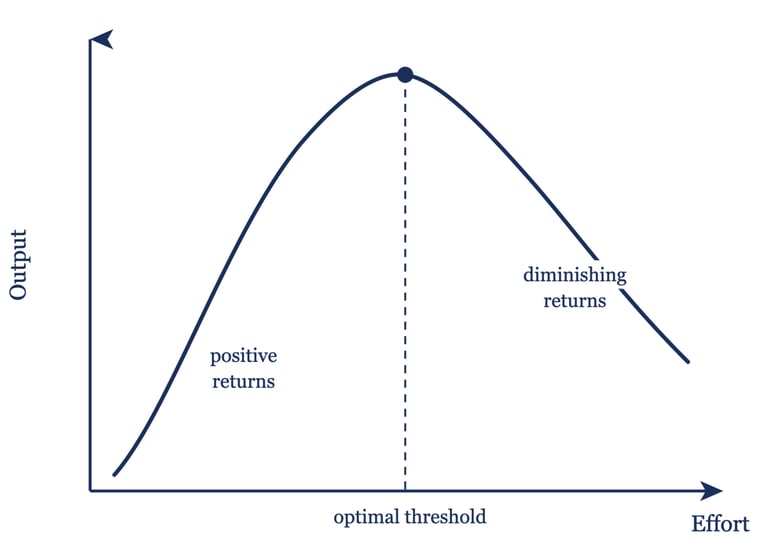
In simple terms: effort compounds positively at first, until it starts compounding negatively beyond a certain threshold. Stopping near that threshold is where a reasonable standard lies. Push beyond it, and one of two things happens:
The result improves in tiny, essentially insignificant increments.
The result actually gets worse from all the overthinking.
So how do we avoid losing that time and effort?
We have to learn to recognize the moment when a task is good enough, and then have the courage to stop there. Easier said than done, of course, because there's another law at play: the law of inertia.
In terms of productivity, inertia works both ways: we fight it when we try to start a task, and again when we try to stop it. The first struggle is commonly called procrastination, and the second one: perfectionism.
When you procrastinate, you spend your energy avoiding what matters. When you're being a perfectionist, you spend the last drips of your energy on what no longer matters.
Procrastination robs you of the joy of accomplishment. Perfectionism steals the satisfaction you earned when the work was already good enough.
Now, I'll acknowledge that some situations genuinely require checking every detail, for example the final edit of a book manuscript—something you can’t revise once it’s published. But these are rarer than we tend to believe. And even then, you'd still likely miss something you've become blind to. Truly perfect work doesn't exist—perfectionists only imagine it does.
We believe the world will crumble if every dot isn’t in its place
Look! I just left out the period at the end of the previous sentence, and we’re still here! 😜
Honestly, I've spent years tweaking things past the point where they stopped improving. Trying to check every detail is a deeply rooted habit I resort to more often than I’d want. But I will keep on practicing to be able to stop when something is done enough.
And you know what they say: practice makes perfect. 🤣
(Pun very much intended.)
Now, all jokes aside, this is an essential concept to grasp when it comes to reaching for elegance in your craft. It’s just not elegant to force yourself to work beyond your limits. Doing elegant work isn’t about adding more, it’s about knowing when nothing more is needed.
What would you say:
How hard do you find it to start and stop a task when you need to?
Does the world crumble if there’s a period missing in a sentence?
Have an elegant weekend!
Bisous,
Elle